If you own a local business, Google Search and Google Maps are probably part of your customer journey whether you actively manage them or not.
A potential customer may search for “house cleaning near me,” “emergency plumber,” “dentist in Henderson,” “best HVAC repair,” “lawyer near me,” or “restaurant open now.” Before they ever visit your website, they may see your Google Business Profile, your reviews, your photos, your hours, your service area, your competitors, and a map of nearby options.
That is why local search matters.
But local search is also confusing. Business owners hear a lot of conflicting advice. Some people say posting on Google Business Profile every week will improve rankings. Others say reviews are everything. Some say your website does not matter anymore. Some promise first-page or Map Pack rankings.
The more useful question is not “Can I guarantee a better Google ranking?”
The better question is:
What parts of local search can a business actually improve in 2026?
The answer is: more than many business owners realize, but not everything.
What Is Local Search?
Local search is any search where Google believes the person is looking for a nearby business, service, product, or location.
That includes obvious searches like:
- “cleaning company near me”
- “Italian restaurant in Las Vegas”
- “emergency AC repair Henderson”
- “North Las Vegas house cleaning”
- “dentist near Summerlin”
It can also include searches where the location is implied. Someone searching for “plumber” or “coffee shop” from their phone may see local results even if they do not type a city name.
Local search results may include Google Maps results, the Google Map Pack, Google Business Profiles, Local Services Ads, traditional organic website results, review sites, directories, business websites, service pages, location pages, and branded searches for a specific company.
This is important because local SEO is not just about one ranking. A business can be discovered in several different ways.
What Is the Google Map Pack?
The Google Map Pack, also called the Local Pack, is the map section that often appears near the top of Google results for local searches. It usually shows a few nearby businesses, their ratings, business categories, hours, location information, and links to call, visit the website, or get directions.
For many local businesses, this area is valuable because it often appears before the standard organic website results. A strong presence in Google Maps and the Map Pack can lead to phone calls, website visits, direction requests, quote requests, and booked jobs.
However, the Map Pack is not static. Results can change based on the searcher’s location, the exact wording of the search, the device being used, business hours, competition, and Google’s ranking systems.
That is why one screenshot of one search from one location does not tell the whole story.
What Google Officially Says About Local Rankings
Google says local results are mainly based on three factors:
Relevance
How well a Business Profile matches what someone is searching for.
Distance
How far each potential result is from the searcher or from the location used in the search.
Prominence
How well known or established a business appears to be, based on information Google has about that business.
Google also says there is no way to request or pay for a better organic local ranking. Paid ads may appear in local search, but that is separate from earning stronger unpaid visibility in Google Search and Maps.
This matters because it gives business owners a realistic framework. Local SEO is not magic. It is the work of improving the parts of relevance and prominence that a business can influence, while understanding that distance and competition still matter.
Relevance: Does Google Understand What You Do?
Relevance is about matching your business to the search.
If someone searches for “house cleaning services,” Google needs to understand whether your business provides house cleaning. If someone searches for “commercial janitorial service,” Google needs to understand whether that is something you offer. If someone searches for “emergency plumber,” Google needs to understand whether emergency plumbing is part of your service.
A business can improve relevance by making its information clear and consistent across its Google Business Profile, website, and other online listings.
Important relevance signals may include:
- The primary Google Business Profile category
- Secondary categories
- Services listed in the Business Profile
- The business description
- Website content
- Page titles and headings
- Service pages
- Location pages
- Internal links
- Reviews that mention specific services
- Photos that reflect the real business
- Consistent business information across the web
For many local businesses, the primary category is one of the first things to review. A wrong or vague category can make it harder for Google to match the business to the right searches.
The website also matters. If your Google Business Profile says you offer a service but your website barely mentions it, you are giving Google less supporting information. A strong local website should clearly explain what the business does, where it operates, and how customers can contact or hire the business.
Distance: The Ranking Factor You Cannot Fully Control
Distance is the uncomfortable part of local SEO.
A business can improve its profile, website, reviews, and prominence, but it cannot be physically close to every searcher.
This is why a business may rank well near its office but poorly across town. A Henderson business may struggle to appear for some Las Vegas searches. A North Las Vegas business may not always show up for people searching from Summerlin. A service-area business may serve a wide area, but Google still has to decide which businesses are most relevant and practical for the person searching.
This does not mean SEO is useless. It means expectations need to be realistic.
Local SEO can improve how strongly your business is associated with specific services and locations. It can help build prominence. It can improve website visibility. It can increase the number of searches where your business has a chance to appear.
But it cannot remove geography from local search.
Prominence: Does Your Business Look Established and Trusted?
Prominence is about how well known, trusted, and established your business appears to be.
Google may consider information from across the web, including links, articles, directories, reviews, ratings, and your position in web results.
This is where many business owners underestimate the website and broader online presence.
Prominence may be influenced by:
- Review count
- Review quality
- Review recency
- Links from other websites
- Local directory listings
- Local press or mentions
- Industry associations
- Sponsorships and partnerships
- Website authority
- Organic search visibility
- Brand searches
- Consistency of business information
- Real-world reputation
A business with years of reviews, a clear website, local mentions, useful service pages, and consistent information is giving Google more confidence than a business with a thin website, few reviews, and scattered or inconsistent listings.
Local SEO Is Not Only Google Business Profile
Google Business Profile is important, but it is not the entire local search strategy.
A complete Business Profile can help Google understand and display your business, but Google also uses information from your website and other sources across the web.
A practical local search strategy should connect:
- Google Business Profile
- The business website
- Reviews
- Service pages
- Location pages
- Local citations
- Backlinks and mentions
- Photos and visual proof
- Tracking and reporting
- Conversion improvements
If the Business Profile and website support each other, the business is easier to understand. If they conflict, are outdated, or are thin, local SEO becomes harder.
Why the Website Still Matters in 2026
Some business owners think the website is less important because customers can call directly from Google. That is partly true, but it misses the bigger picture.
Your website helps Google understand your business in more detail than a Business Profile alone.
A strong local website can explain:
- Your main services
- Your service area
- Your process
- Your pricing approach
- Your experience
- Your licenses or qualifications
- Your guarantees or policies
- Your customer types
- Your local relevance
- Your proof of work
- Your contact options
For example, a cleaning company may need pages for recurring house cleaning, move-out cleaning, deep cleaning, apartment cleaning, and office cleaning. A contractor may need pages for kitchen remodeling, bathroom remodeling, additions, and specific service areas. A law firm may need pages for each practice area and city served.
These pages should not be thin doorway pages that only swap out city names. They should provide useful information for real customers.
A good local service page answers questions like:
- What service is provided?
- Who is it for?
- Where is it available?
- What problems does it solve?
- What should a customer expect?
- What makes the business credible?
- How does someone request service?
That kind of content helps both customers and search engines.
Reviews Matter, But They Are Not Everything
Reviews are one of the most visible parts of local search. Customers see them immediately, and Google says more reviews and positive ratings can improve local ranking.
However, reviews should be handled carefully.
A good review strategy should focus on:
- Asking real customers for honest feedback
- Making the review process easy
- Responding to reviews professionally
- Learning from negative feedback
- Avoiding fake reviews
- Avoiding paid review schemes
- Avoiding pressure or review gating
Review quality matters for customers. Review content can also help reinforce what the business does. A review that says “they did a great move-out cleaning for my apartment in Las Vegas” provides more useful context than a generic “great company.”
But reviews alone do not fix everything. A business with strong reviews but a weak website, wrong category, poor photos, inconsistent information, or bad service pages may still underperform.
Photos, Posts, Products, and Services: Useful, But Not Magic
Google Business Profile includes features such as photos, updates, services, products, booking links, Q&A, and business descriptions. These features can be useful because they help customers understand the business.
Photos can show real work, real staff, vehicles, offices, before-and-after examples, completed projects, or the atmosphere of a location.
Services can clarify what the business offers.
Posts can share updates, offers, seasonal information, or helpful reminders.
But these features should not be treated as magic ranking buttons.
Posting every week does not guarantee better local rankings. Adding dozens of services does not automatically create more leads. Uploading random stock photos will not build trust like real photos can.
The main value is clarity, accuracy, usefulness, and conversion.
What Business Owners Can Control
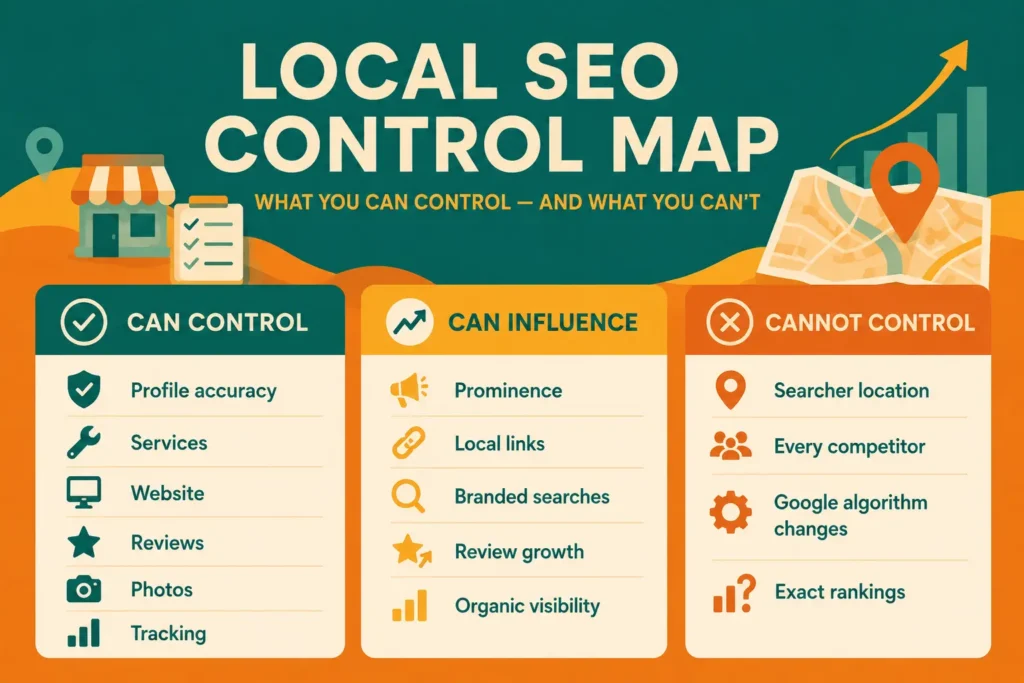
A business cannot control everything in local search, but it can control more than many owners realize.
You can control whether your Business Profile is accurate.
You can control whether your categories are carefully chosen.
You can control whether your website clearly explains your services.
You can control whether your service pages are useful.
You can control whether your phone number, hours, and contact information are correct.
You can control whether you ask real customers for reviews.
You can control whether you respond professionally.
You can control whether your photos look real and current.
You can control whether your local listings are consistent.
You can control whether you track calls, clicks, forms, and leads.
You can control whether you keep improving instead of treating local SEO as a one-time setup.
Those are the areas where local SEO work can make a real difference.
What Business Owners Cannot Control
A business cannot control the searcher’s exact location.
It cannot control every competitor.
It cannot force Google to rank it first.
It cannot make a new business look as established as a competitor with hundreds of legitimate reviews overnight.
It cannot buy organic Map Pack rankings directly from Google.
It cannot guarantee that a specific search will show the same result for every person in every neighborhood.
It cannot overcome a weak offer, poor service, or bad customer experience forever.
This is why local SEO should be presented as a competitive improvement process, not a guaranteed ranking package.
How to Measure Local SEO in 2026
Ranking reports can be useful, but they are not enough.
A business owner should look at several types of local SEO data.
Google Business Profile metrics
Useful Business Profile metrics can include:
- Profile views
- Calls
- Website clicks
- Direction requests
- Messages, if enabled
- Bookings, if enabled
- Interactions over time
- Search terms where available
These metrics help show whether people are seeing and interacting with the Business Profile.
Google Search Console metrics
Search Console can show how the website performs in Google organic search.
Useful things to review include:
- Total clicks
- Total impressions
- Click-through rate
- Average position
- Branded searches
- Non-branded service searches
- Location-based searches
- Pages gaining impressions
- Pages getting clicks
- Search terms with high impressions but low clicks
Search Console is especially useful because local SEO often starts with impressions before it becomes clicks and leads. If Google starts showing a page more often for relevant searches, that can be an early sign of progress even before rankings are strong.
Lead and conversion metrics
The most important question is not only “did rankings improve?”
The better question is “did the business get more useful opportunities?”
Track:
- Phone calls
- Contact form submissions
- Quote requests
- Bookings
- Direction requests
- Lead quality
- Spam leads
- Closed jobs
- Revenue, when possible
A local SEO campaign that increases visibility but produces no calls or leads may need better conversion work. A campaign that produces fewer but better leads may be more valuable than one that creates a lot of low-quality activity.
Common Local SEO Mistakes
Many local businesses struggle because of basic issues that are never fixed.
Common mistakes include:
- Choosing the wrong Google Business Profile category
- Using an outdated phone number or address
- Ignoring holiday hours
- Using stock photos instead of real photos
- Not responding to reviews
- Having no service pages on the website
- Creating thin city pages with nearly identical text
- Stuffing keywords into the business name
- Using a fake address or inappropriate virtual office
- Buying fake reviews
- Ignoring mobile website speed and usability
- Linking the Business Profile to a weak or irrelevant page
- Tracking one search result from one location and assuming it represents all local visibility
- Treating Google Business Profile as separate from the website
Fixing these issues is not glamorous, but it often matters.
A Practical Local SEO Checklist for Business Owners
Here is a practical checklist for reviewing local search visibility in 2026.
Google Business Profile
- Is the business name accurate and compliant?
- Is the primary category the best possible match?
- Are secondary categories useful and relevant?
- Are services complete and clearly written?
- Are hours and holiday hours correct?
- Is the website link going to the best page?
- Are phone number and contact details accurate?
- Are service areas realistic?
- Are photos real, current, and helpful?
- Are reviews being answered?
- Are profile updates used when they make sense?
- Are there duplicate or outdated profiles?
- Are there suspicious edits or profile issues?
Website
- Does the homepage clearly say what the business does and where?
- Are the main services supported by dedicated pages?
- Are important locations or service areas explained clearly?
- Is contact information easy to find?
- Does the site work well on mobile?
- Are title tags and headings clear?
- Are pages internally linked in a logical way?
- Is there useful proof, such as reviews, photos, examples, credentials, or years in business?
- Is LocalBusiness or Organization structured data appropriate?
- Is the website fast enough for real users?
- Can a customer easily call, request a quote, book, or send a message?
Reviews and reputation
- Is there a consistent process for asking customers for reviews?
- Are reviews recent?
- Do reviews mention real services and locations?
- Are negative reviews handled professionally?
- Are fake or suspicious reviews avoided?
- Are testimonials or review highlights used on the website where appropriate?
Local prominence
- Are major directories accurate?
- Are industry listings accurate?
- Are there local sponsorships, memberships, partnerships, or mentions?
- Are there useful backlinks from real local or industry sources?
- Is the brand being searched by name?
- Are there case studies, project pages, or examples of real work?
Tracking
- Is Google Search Console installed?
- Is Google Analytics installed, if useful?
- Are phone calls tracked?
- Are form submissions tracked?
- Are quote requests or bookings tracked?
- Are Google Business Profile interactions reviewed regularly?
- Are reports focused on leads and visibility, not just rankings?
When Google Business Profile Management Is Worth Paying For
Google Business Profile management may be worth paying for when a business depends on local customers and does not have the time, experience, or consistency to manage local search properly.
It is especially useful when:
- The business gets customers from Google Search or Maps
- The profile information is incomplete or outdated
- Competitors have stronger profiles and reviews
- The website does not clearly support local services
- The business serves multiple cities or neighborhoods
- Reviews are inconsistent or unmanaged
- The owner does not know what to track
- The business needs steady improvement but not a huge marketing budget
It may not be worth paying for if the business has no realistic local demand, no capacity to answer calls, no interest in customer reviews, or no willingness to improve the website or customer experience.
Local SEO works best when the business is also operationally ready to turn visibility into customers.
What a Realistic Local SEO Campaign Looks Like
A realistic local SEO campaign usually starts with cleanup and clarity.
First, the Business Profile is reviewed for accuracy, categories, services, hours, photos, reviews, and profile issues.
Second, the website is reviewed to see whether it clearly supports the business’s main services and locations.
Third, tracking is checked so calls, clicks, forms, and search visibility can be measured.
Fourth, improvements are made over time. This may include better service pages, better internal links, review process improvements, local citations, new photos, better calls to action, and stronger location relevance.
The process is not instant. Local SEO often improves in stages:
- Google understands the business better.
- Impressions increase for relevant searches.
- Some pages or profile views begin gaining traction.
- More people click, call, request directions, or submit forms.
- The business learns which searches and pages produce real leads.
- The strategy is refined based on data.
That is much more realistic than promising instant Map Pack rankings.
Real-World Local SEO Examples
Local SEO looks different depending on the business.
A cleaning company may need stronger service-area pages, better review generation, more real photos, and clearer descriptions of services such as recurring cleaning, deep cleaning, move-out cleaning, and office cleaning.
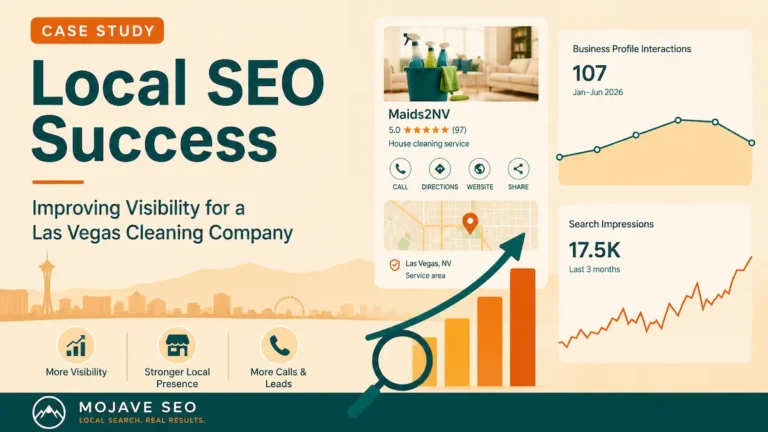
For example, Mojave SEO documented this type of work in a local SEO case study for a Las Vegas-area cleaning company. The project focused on Google Business Profile management, website improvements, better local visibility tracking, and practical advertising recommendations.
A contractor may need project examples, service pages, location pages, before-and-after photos, and proof of licenses or experience.
A dentist may need strong review management, clear treatment pages, insurance or payment information, and a website that makes appointment requests easy.
A restaurant may need accurate hours, current photos, menu links, review responses, and correct information across Google Maps, Apple Maps, Yelp, and other platforms.
The same local SEO framework applies, but the details should match the business, customer journey, and competition.
The Bottom Line
A business can improve local search visibility in 2026, but it cannot control everything.
Google’s local results are influenced by relevance, distance, and prominence. Distance will always matter. Competition will always matter. Google’s systems will continue to change.
But a business can improve how clearly it is understood, how trustworthy it appears, how useful its website is, how complete its profile is, how strong its reviews are, and how well its local search performance is measured.
That work can help a local business compete more effectively in Google Search and Maps.
Mojave SEO Google Business Profile Management
Mojave SEO helps local businesses improve their Google Business Profile and local search presence with practical, factual, no-nonsense management.
The focus is on the work that business owners can actually control: accurate profile information, better service and location relevance, stronger website support, review process improvement, tracking, reporting, and steady local search improvements over time.
No fake ranking guarantees. No shortcuts. Just practical local SEO work designed to help real businesses become easier to find, understand, and contact.